Would you like help choosing your Social Security strategy?
The “SOCIAL SECURITY ELEPHANT” in the Room:
When, Why, and How Should I File for Social Security to Balance my Benefits, Tax Exposure, and Retirement Lifestyle?
Social Security is one of the largest sources of retirement income for many Americans. Yet the rules surrounding when and how to claim benefits are complex and often difficult to navigate.
Research suggests that many retirees claim Social Security earlier than the age that could increase lifetime retirement spending under certain planning assumptions.1 In fact, the difference between claiming early and waiting could potentially mean more income over a lifetime of retirement.2
At the same time, the Social Security Administration has acknowledged that its representatives do not provide individualized claiming advice, and past misunderstandings have led to costly filing decisions.3
There is no one-size-fits-all Social Security strategy. With more than 2,700 rules and hundreds of filing combinations to consider, the right decision depends on your income needs, tax situation, health, and long-term retirement goals.4, 5
Within these rules are important considerations that can influence how and when you choose to file, how benefits are coordinated between spouses, and how Social Security fits into your broader retirement income plan.
This guide breaks down those considerations into clear, practical steps so you can approach your claiming decision with greater clarity and confidence.
Would you like help choosing your Social Security strategy?
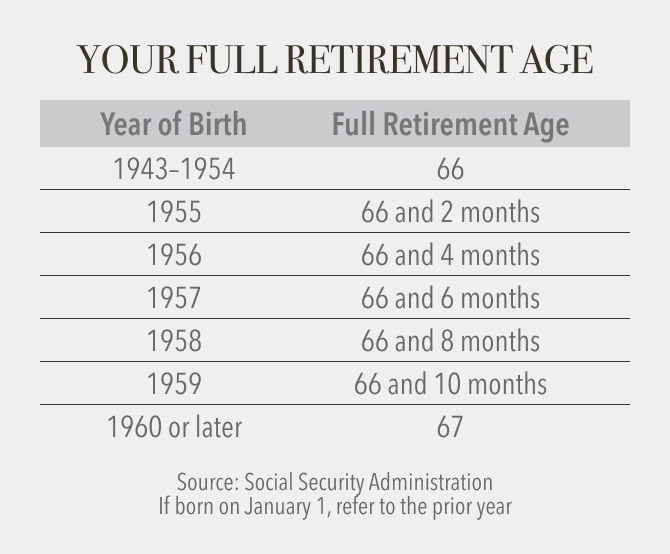
The #1 question that's on many people's minds as they approach retirement is, when should they claim Social Security? You'll be eligible to claim 100% of your Social Security benefit at your Full Retirement Age, but you're allowed to claim Social Security as early as age 62. Depending on when you were born, your Full Retirement Age is between age 66 and 67.
KEY CONSIDERATION:
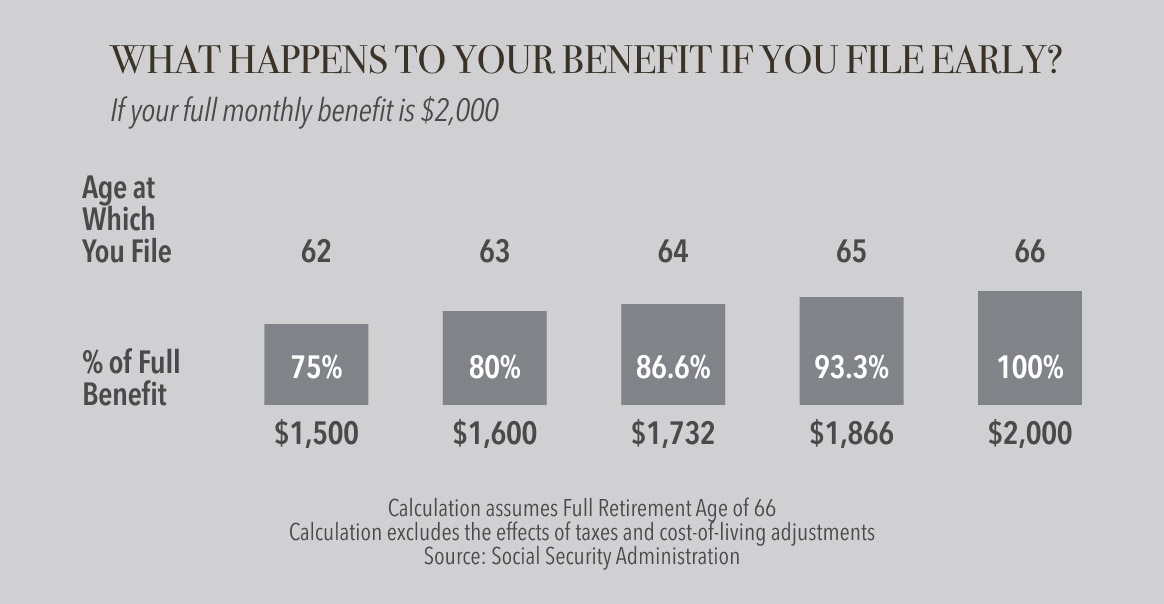
The earlier you file, the less you'll receive in benefits each month – for as long as you continue claiming.
Let’s talk about when you can claim Social Security.
CLAIM SOCIAL SECURITY
EARLY
(Between ages 62 and 67)
While claiming Social Security early reduces your monthly benefit, it also means that you'll be collecting checks longer. Delaying benefits by one year could increase the size of your benefit by 5% to 8%, depending on your age at the time.6
Here are a few common reasons why you might want to claim Social Security early:
- You need income early in retirement.
- You don't want to draw down your retirement savings yet (and want to let them grow at market rates).
- You have a high-earning spouse, and want to let their benefit potentially grow while claiming your own.
- You believe you might have a lower life expectancy than average.
CLAIM SOCIAL SECURITY AT
YOUR FULL RETIREMENT
(Ages 66–67)
If you claim at your Full Retirement Age (FRA), you'll get 100% of your full benefit, but you'll give up the opportunity to let your benefit continue to grow.
There are 3 primary reasons to claim at your FRA:
- You get 100% of your FRA benefit.
- You can work and still collect your full benefit (because the Annual Earnings Limitation no longer applies).
- You can suspend your benefits at any time to allow them to start growing again
CLAIM SOCIAL SECURITY AT
AGE 70
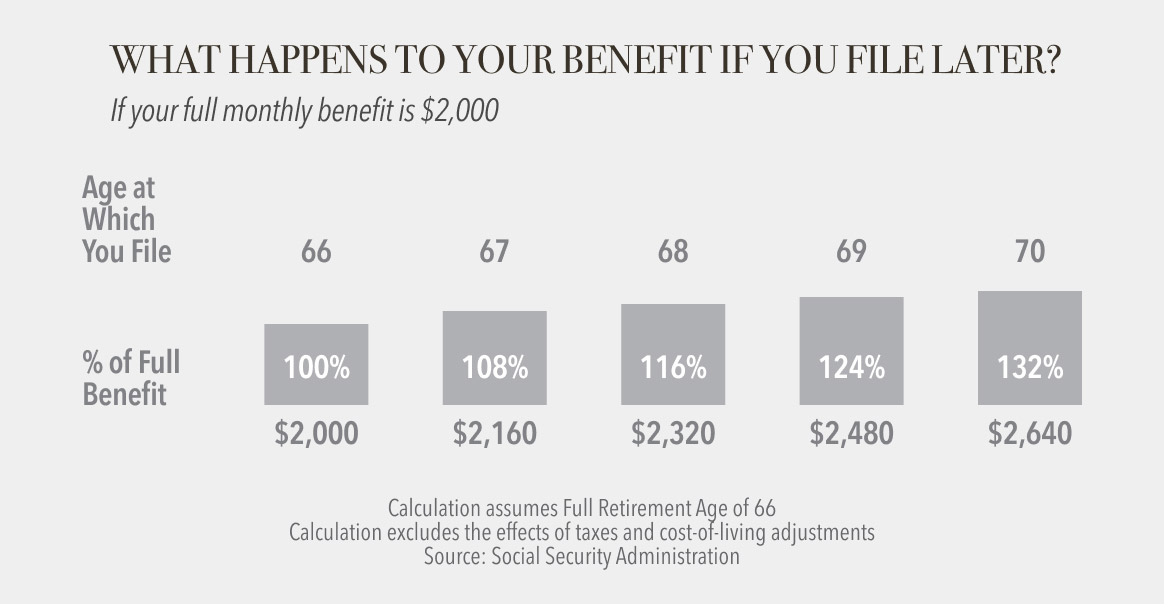
If you delay claiming Social Security past your Full Retirement Age, your benefit will grow each year until you reach age 70. Since delayed retirement credits stop at age 70, there is typically no financial advantage to delaying beyond that age.
Wondering when is the best time for you to file for Social Security so you can balance your benefits, tax exposure, and retirement lifestyle?
Would you like help choosing your Social Security strategy?
These are some of the key questions asked of clients when discussing Social Security and retirement income.
What Other Sources of Retirement Income Do You Have?
If you're thinking about retiring and have enough income from other sources, you have the luxury of flexibility. If you are able to create a stream of income from other sources you may be able to delay claiming Social Security until your Full Retirement Age or later, depending on your overall retirement plan.
Alternatively, you may want to consider claiming Social Security as early as possible to give your investments more time in the market. This calculation depends on a number of variables that can be evaluated using professional financial software.
Are You Married?
Married people have more options to consider, since they can choose to claim on their own record or choose to claim on their spouse's record (if they are eligible). You'll also want to consider your spouse's (and your own) survivor benefits to help ensure a surviving spouse has adequate income.
Though the “File and Suspend” loophole no longer applies for most retirees, there are still a number of additional claiming options that may help coordinate income between spouses over time.
What Are Your Family Health History and Longevity Expectations?
How long you expect to live is a crucial factor in your personal Social Security calculation. If you live to your exact average expected age, you'll collect the same total income whether you collect early or late (Social Security is designed this way). If you expect to live longer than the break-even age, you may be better off waiting to claim to receive a larger monthly benefit.
The exact age at which your lifetime benefits are highest also depends on variables like the amount of your benefit, your tax bracket, and how your retirement portfolio is performing. A personalized projection can help you evaluate what may make the most sense for your situation.
Will You Work While Claiming Social Security?
If you intend to work while claiming Social Security, it’s important to consider two additional factors: the Annual Earnings Limit (which applies to those under their Full Retirement Age) and taxes. If your overall income (including Social Security and income from other sources) is above certain annual thresholds, more of your benefit may become taxable. If you'd like to explore ways to manage how Social Security fits into your broader tax picture, we can review strategies that may help reduce your overall taxable income.
Would you like help preparing a personal Social Security Strategy or guidance answering any of these questions?
Would you like help choosing your Social Security strategy?
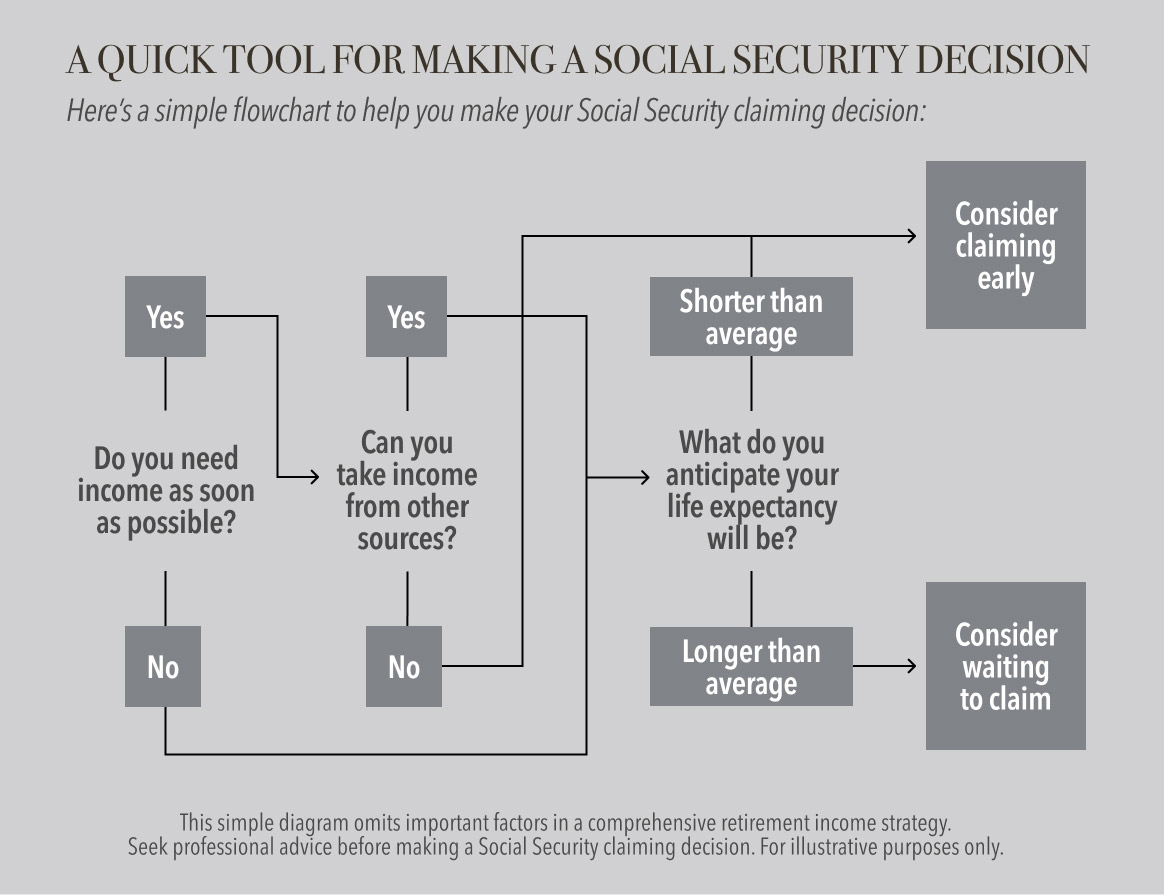
If you've read this far, you understand that many variables come into play when making a Social Security claiming decision. This simple flowchart helps you think through some of the key questions that shape your personal claiming strategy.
Would you like help choosing your Social Security strategy?
The Social Security Option You Choose Could Mean a Difference of Thousands of Dollars Per Year
While claiming your Social Security benefits can be as simple as filing an application on the Social Security Administration's website, it is not a decision to take lightly. Before you claim, I encourage you to consider the following steps:
Step 1: Consider all the options available to you and your spouse.
Step 2: Talk to a professional about how Social Security fits into your broader retirement income plan.
Step 3: If you think you've made a mistake in filing, contact our office to discuss your options. In certain situations, it may be possible to withdraw your application and refile, depending on SSA rules.
Here’s what working with a professional on your Social Security and retirement income strategy may include:
- Access to software that analyzes Social Security rules and illustrates different claiming scenarios.
- A personalized review of available claiming strategies, where applicable.
- A coordinated income and tax review to evaluate how withdrawals and Social Security benefits interact.
If you've already started claiming Social Security, it may not be too late to review your decision. In limited cases, the Social Security Administration allows individuals to withdraw their application within 12 months of first claiming benefits. To do so, you must repay all benefits received, and approval is subject to SSA rules and requirements. Reviewing your situation can help determine whether this option is available and appropriate for you.
Would you like help choosing your Social Security strategy?
Book a COMPLIMENTARY 1-on-1 Social Security Session!
We never spam. By clicking this button, you consent to be contacted by Dan Suiter, CFP®, AIF® by phone, email, and/or automated SMS. You may unsubscribe at any time. Consent is not a condition of receiving services.

Dan Suiter, CFP®, AIF®
The Schamber Group



Sources
- AARP, 2025 [URL: https://www.aarp.org/social-security/early-retirement-benefits-poll]
- U.S. News & World Report, 2025 [URL: https://money.usnews.com/money/retirement/articles/should-you-claim-social-security-early]
- SSA OIG, 2024 [URL: https://oig.ssa.gov/news-releases/2024-08-19-ig-reports-nearly-72-billion-improperly-paid-recommended-improvements-go-unimplemented]
- Social Security Administration, 2026 [URL: https://www.ssa.gov/OP_Home/handbook/handbook-toc.html]
- AMAC Foundation, 2024 [URL: https://amacfoundation.org/social-security-myths-and-misunderstandings]
- The Motley Fool, 2026 [URL: https://www.fool.com/retirement/social-security/how-much-social-security-increase-after-62/]
Risk Disclosure: Investing involves risk including the potential loss of principal. No investment strategy can guarantee a profit or protect against loss in periods of declining values. Past performance does not guarantee future results.
This material is for information purposes only and is not intended as an offer or solicitation with respect to the purchase or sale of any security. The content is developed from sources believed to be providing accurate information; no warranty, expressed or implied, is made regarding accuracy, adequacy, completeness, legality, reliability, or usefulness of any information. Consult your financial professional before making any investment decision. For illustrative use only.
This information is not intended to be a substitute for specific individualized tax advice. We suggest that you discuss your specific situation with a qualified tax professional.
This information is not affiliated with or endorsed by the Social Security Administration or any government agency.
Financial planning and advisory services are offered through The Schamber Group, Inc., a Registered Investment Advisor.